dMAT Germany 2026: Format, Scores, Exemptions and APS Connection
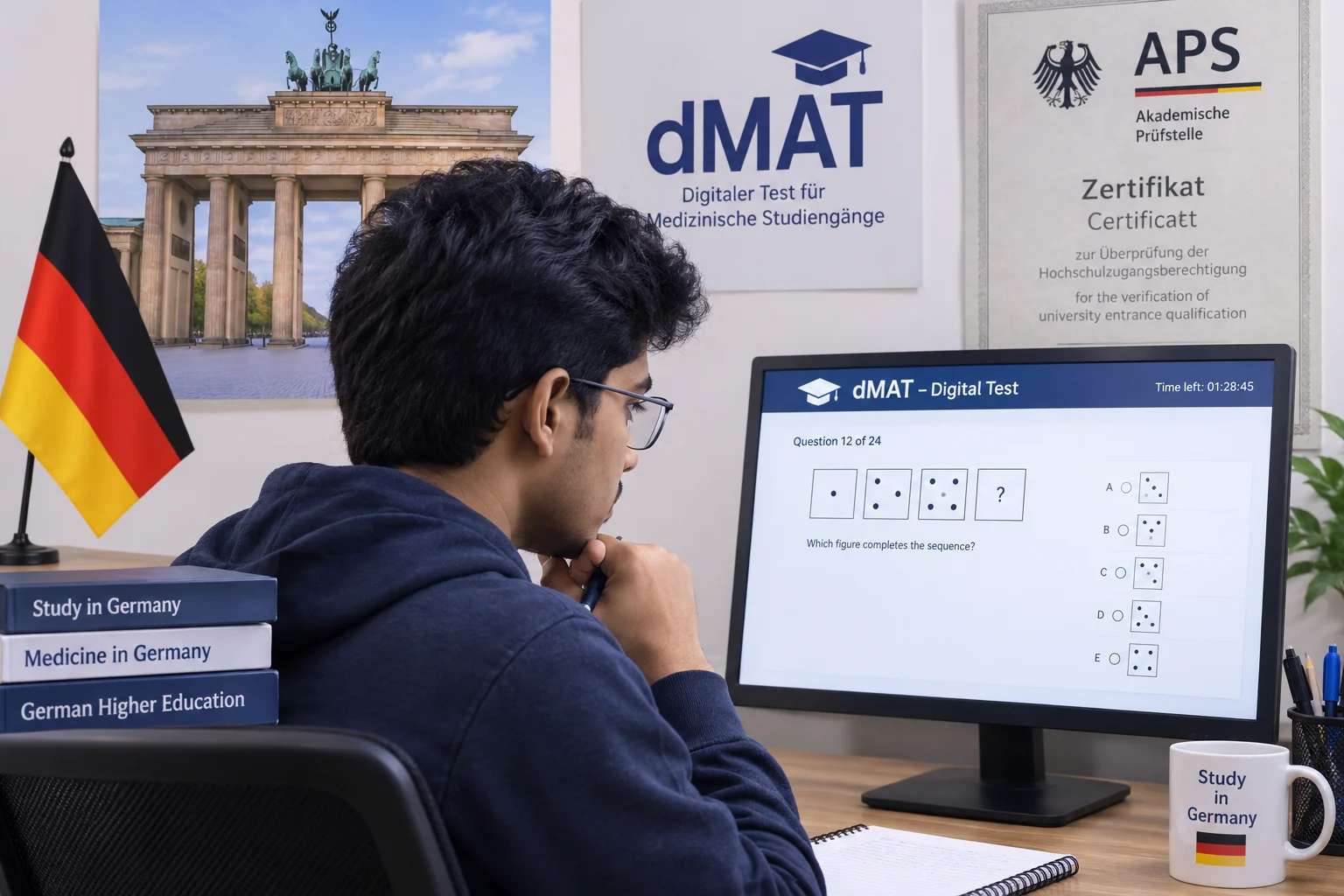
Planning to study for a Master’s degree in Germany? You may now need to take the digital Master Test, commonly called dMAT.
The test is connected with the APS process for selected Indian students applying for Master’s programmes from the Summer Semester 2027 intake onwards.
However, dMAT is not compulsory for everyone. This guide explains who needs it, how the exam works and how it affects your APS certificate.
What Is dMAT?
The dMAT is a digital academic aptitude test conducted by g.a.s.t.
It checks whether students can:
- recognise patterns;
- solve mathematical problems;
- understand academic texts;
- interpret tables and formulas;
- apply knowledge to new situations.
The test does not replace your university grades, APS verification or German university admission requirements.
Who Needs to Take dMAT?
You may need dMAT when:
- you are applying for a Master’s degree in Germany;
- your intake is Summer Semester 2027 or later;
- your previous degree is in an affected field;
- you do not qualify for an exemption.
The main affected fields include:
- Engineering;
- Commerce;
- Accounting;
- Finance;
- Economics;
- Business;
- Management.
Degrees such as B.Tech, B.E., B.Com, BBA, BMS and Economics programmes may fall under the requirement.
For interdisciplinary degrees such as Business Analytics, Engineering Management or Financial Technology, APS may check the exact degree title and subjects listed on your transcript.
Who Is Exempt?
You may not need dMAT if you are:
- applying for a Bachelor’s degree;
- applying for a PhD;
- from a degree field outside the affected categories;
- part of an approved exchange, partnership or double-degree programme;
- already holding an APS certificate from a completed application;
- registered with APS before the official transitional cut-off date.
Always check the latest APS India rules before applying.
dMAT Exam Format
The examination has two main parts.
1. Core Module
The Core Module includes:
SectionQuestionsTimeFigure Sequences2025 minutesMathematical Equations2025 minutesLatin Squares2025 minutes
2. General Academic Module
This section lasts approximately 90 minutes.
It may include academic texts, diagrams, tables, formulas and problem-solving questions from areas such as:
- mathematics;
- engineering;
- natural sciences;
- economics;
- business;
- humanities;
- social sciences.
The test focuses more on reasoning and application than memorisation.
How Does dMAT Scoring Work?
Each module receives a standardised score between 0 and 200.
A score of around 100 represents average performance in the reference group.
Your certificate may show:
- Core Module score;
- General Academic Module score;
- total score;
- percentile rank.
A percentile rank of 70 means you performed as well as or better than approximately 70% of test participants.
Is There a Passing Score?
There is currently no single dMAT passing score for every German university.
APS does not treat dMAT as a simple pass-or-fail examination. A lower score does not automatically mean that your APS certificate will be rejected.
However, German universities may decide how much importance they give to the score during admission.
How Is dMAT Connected with APS?
dMAT and APS have different roles.
g.a.s.t. manages:
- test registration;
- examination centres;
- fee payment;
- test results;
- dMAT certificates.
APS India manages:
- verification of academic documents;
- assessment of Indian qualifications;
- issuance of the APS certificate.
For affected applicants, the dMAT certificate becomes part of the APS process.
You may submit your APS documents before receiving your dMAT result. However, APS may issue the final certificate only after receiving and verifying the dMAT certificate.
dMAT Fee and Registration
The announced dMAT fee is €150.
This fee is separate from:
- the APS application fee;
- document courier charges;
- university application fees;
- visa-related expenses.
Test centres have been announced in major Indian cities, including New Delhi, Mumbai, Pune, Bengaluru, Chennai, Kolkata, Ahmedabad and Chandigarh.
Seats may be limited, so early registration is recommended.
How to Prepare for dMAT
Use a simple four-step strategy:
Understand the Format
Study the official sample questions and learn how every section works.
Improve Accuracy
Practise visual patterns, basic algebra, Latin squares and academic reading.
Add Time Limits
Complete practice questions using the official section timings.
Take Full Mock Tests
Simulate the complete examination without notes and with limited breaks.
Because the test is fast-paced, time management is just as important as subject knowledge.
Common Mistakes to Avoid
- Assuming every Master’s applicant needs dMAT.
- Confusing dMAT with the APS certificate.
- Waiting for the result before starting the APS process.
- Ignoring the recognition status of your university.
- Depending only on unofficial coaching material.
- Registering too late and losing your preferred test centre.
Frequently Asked Questions
Is dMAT mandatory for all Indian students?
No. It currently applies only to selected Master’s applicants from affected academic fields.
Does dMAT replace APS?
No. It is an additional requirement within the APS process for eligible applicants.
Can I apply for APS before taking dMAT?
Yes. You can submit your other APS documents first and provide the dMAT certificate later.
Can a low score cause APS rejection?
A low score does not automatically lead to APS rejection. However, universities may consider the result during admission.
Does dMAT replace IELTS or TOEFL?
No. Language requirements are separate and depend on the university programme.
Can a high dMAT score guarantee admission?
No. Admission depends on your academic background, university requirements, language proficiency and overall application.
Final Advice
Before registering for dMAT, confirm:
- your exact degree category;
- your intended intake;
- your APS registration status;
- possible exemptions;
- your university’s recognition status.
Once you know that dMAT applies to you, register early and prepare using official materials.
Need Personalized Guidance on dMAT and APS?
Every student’s situation is different—your degree, APS registration date, intended intake, exemption status, and university requirements determine whether dMAT applies to you. Our Germany experts help you understand the rules, prepare correctly, and avoid costly application delays.
EasyWay Germany has helped 1,000+ Indian students navigate APS requirements, shortlist German universities, and plan successful Master’s applications with confidence..
Need Help With Your Germany Application?
Choosing universities, writing a strong SOP and getting the APS right all have to happen in the right order. EasyWay Germany's consultants live in Dresden and have helped students from India, Bangladesh and Nepal with university shortlisting, SOP and LOR writing, and CV preparation. Explore our study in Germany services or book a free consultation.